

AI-powered video technology is reshaping how modern businesses communicate, create content, and extract meaningful insights from visual data. From smarter conferencing to automated editing and powerful analytics, these tools are becoming essential across a wide range of industries.
What AI Video Solutions Actually Do
At their core, AI video solutions combine artificial intelligence, cloud infrastructure, and advanced analytics to improve how video is captured, processed, and understood. Rather than relying on manual review or basic automation, these platforms can identify objects, people, actions, and patterns within footage far more accurately and efficiently than older methods (source). The result is a smarter, faster workflow that supports everything from live conferencing to large-scale content production.
Industries such as retail, manufacturing, media, and security have all found practical applications for these technologies. Whether the goal is improving the quality of a video call, moderating user-generated content, or automatically generating captions, AI video platforms address a broad set of business challenges in one integrated approach (source).
Enhancing Video Conferencing with Intelligent Features
One of the most immediate benefits businesses notice is how AI transforms the quality and accessibility of video meetings. Modern intelligent video systems can sharpen image resolution, correct color automatically, and reduce distracting background noise—all without requiring any manual adjustments from the user (source). These enhancements make professional-grade conferencing accessible even in less-than-ideal environments.
Accessibility features are another major area where AI is making a measurable difference. Closed captioning, audio descriptions, and sign language interpretation capabilities allow participants with different needs to engage fully in meetings and collaborative sessions (source). For organizations that prioritize inclusivity, these tools represent a meaningful step forward in how teams connect across locations and abilities.
AI Video Editing Tools for Content Teams
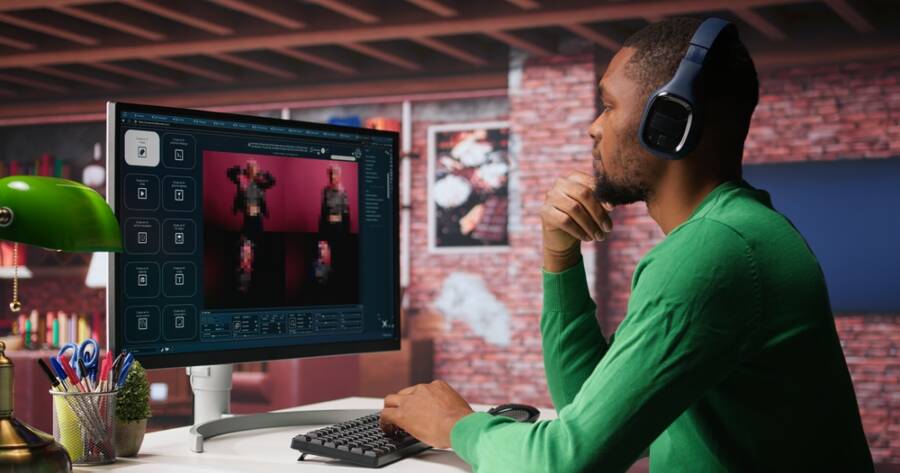
Content creators and marketing teams have long spent significant time on video post-production. AI-powered editing platforms are changing that dynamic by automating the most time-consuming parts of the process. Tools like Loom now use AI to detect and remove awkward pauses, clean up audio inconsistencies, and cut out unnecessary footage automatically, reducing the editing burden considerably (source).
Other platforms expand what’s possible even further. Synthesia, for example, allows businesses to produce polished videos using AI-generated avatars and voiceovers in more than 140 languages and accents—eliminating the need for physical cameras, actors, or production crews (source). This makes localized content creation scalable in a way that simply wasn’t feasible before. Similarly, Runway ML brings together background removal, text-to-video generation, and AI-powered audio features in a single platform, making complex production tasks manageable for smaller teams (source).
When evaluating which AI video editing tool fits a given organization’s needs, decision-makers should weigh factors such as ease of use, the depth of AI-driven editing features, caption and transcription generation, customization capabilities, and how well the platform supports team collaboration (source). Not every tool is built for every use case, so matching the platform to the team’s workflow is critical.
Enterprise-Grade Video Analytics and Content Intelligence
Beyond editing and conferencing, AI video technology plays a critical role in large-scale data analysis and content intelligence. Google Cloud’s Video Intelligence API, for instance, is capable of recognizing more than 20,000 distinct objects, places, and actions across both stored footage and live streams, pulling detailed metadata at the video, shot, or frame level (source). This level of granularity opens up entirely new possibilities for how businesses use video data.
Practical enterprise applications include content moderation at scale, building recommendation engines based on video context, indexing large media archives for fast retrieval, and placing contextually relevant advertisements tied to specific moments within a video (source). These capabilities are particularly valuable for media companies, streaming services, and any organization managing high volumes of video content.
The platform also supports near real-time insights through streaming video annotation and object-based event triggers, enabling teams to build dynamic and responsive customer experiences (source). For businesses that rely on timely information from video data, this kind of real-time processing capability is a significant operational advantage.
Automating Reports, Highlights, and Alerts
One often-overlooked advantage of intelligent video platforms is their ability to automate the downstream work that follows video capture. Rather than requiring staff to manually sift through footage to find key moments, AI systems can generate highlight reels, apply text overlays, and identify relevant clips automatically (source). This frees up team resources for higher-value tasks while keeping content pipelines moving efficiently.
Alert and reporting features also allow organizations to stay informed without dedicating constant human attention to video feeds. When defined conditions are detected in a video stream, the system can automatically notify the appropriate team members and generate reports that surface key information quickly (source). In fast-moving business environments, that kind of automation can significantly improve response times and overall decision-making quality.
Why You Should Learn More About AI Video Solutions Today
AI video technology has evolved from a specialized tool into a practical asset for businesses across virtually every sector. From enhancing the clarity of daily video calls to powering sophisticated content moderation systems and automating post-production workflows, these platforms deliver measurable value at multiple levels of an organization. The accessibility features built into modern intelligent video systems also ensure that teams of all abilities can participate and contribute effectively. As the range of available tools continues to expand, understanding how these solutions align with specific business goals becomes increasingly important. Organizations that take the time to evaluate their options thoughtfully are better positioned to build smarter, more efficient video-driven workflows for the long term.